

#27 The Peacock
Today, we meet Shakespeare’s most extravagant bird, the peacock.

Greetings!
Today, we turn to Shakespeare’s most extravagant bird, the peacock, an emblem for royalty, pride, beauty, and vanity.
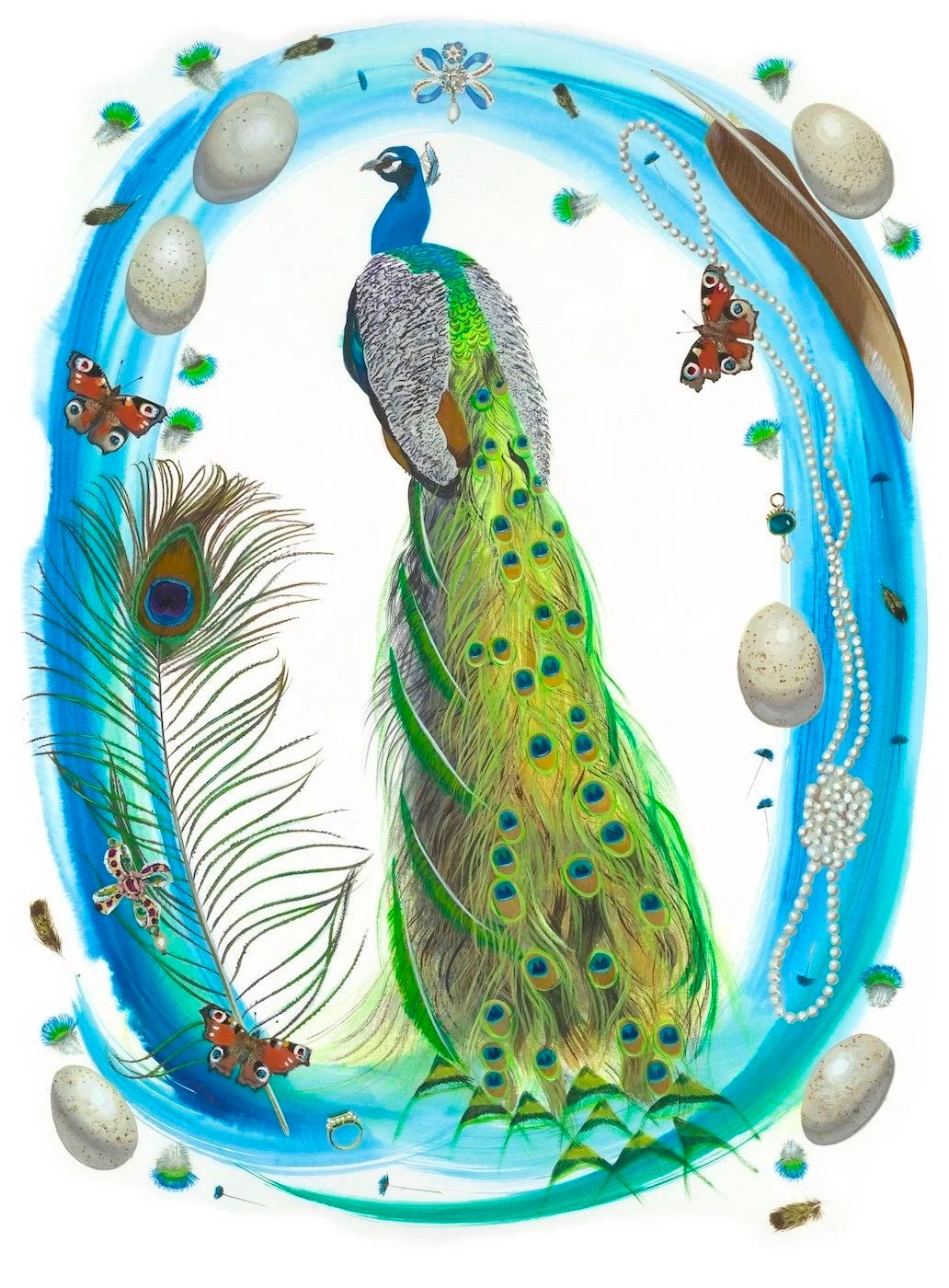
Image: Peacock (Pavo cristatus) by Missy Dunaway, 30x22 inches, acrylic ink on paper
Facts About the Peacock
I have a flock of chickens and, out of curiosity, once looked into what it would be like to own a peacock. I came across a memorable tip from peafowl breeders: peacocks are fast and difficult to catch, so if one escapes, wait until nightfall, when it roosts in a tree. Climb a ladder or the tree to grab the bird, then carry it home in your arms. Peacocks are apparently very heavy sleepers and will sleep through the whole ordeal.
I can say from experience that chickens, which are related to peacocks, are also heavy sleepers and can even snore.
More facts about the peacock:
The blue Indian peafowl is native to India and Sri Lanka.
It was imported to England by Sir John Foxley in the 14th century.
The word “peacock” only refers to the male peafowl. The female is called a peahen.
Peafowl belong to the order Galliformes, which includes chickens, pheasants, and quail. They are among the largest birds capable of flight.
The peacock’s train is made up of about two hundred feathers, each up to five feet long. These feathers grow not from the tail but from the bird’s back. The shorter tail feathers underneath lift and support the long display feathers, creating the familiar fan.
The dramatic sexual dimorphism between the colorful male peacock and the drab female peahen is one of the most familiar examples of the Fisherian runaway mechanism, an evolutionary process in which exaggerated traits and mate preference reinforce one another across generations.
Peacocks in Western History
We find the peacock in written records across centuries, from Roman mythology and emblem books to the personal letters of Darwin and an essay by Francis Bacon.
In Roman mythology, the peacock is the companion of Juno, the wife of Jupiter and queen of the Roman gods.
The peacock is the titular character in five of Aesop’s fables: Juno and the Peacock, The Jay and the Peacock, The Peacock and the Nightingale, The Peacock and the Pie, and The Crane and the Peacock.
The peacock was also eaten. Medieval and early modern royal banquets sometimes featured a roasted peacock presented with a gilded beak.
Knights swore vows upon the bird before feasts, which led to the common swear, “by cock and pie,” which likely refers to the peacock and the magpie. To swear upon the peacock was to make an oath to nobility. To swear upon the magpie was to make an oath to common people.
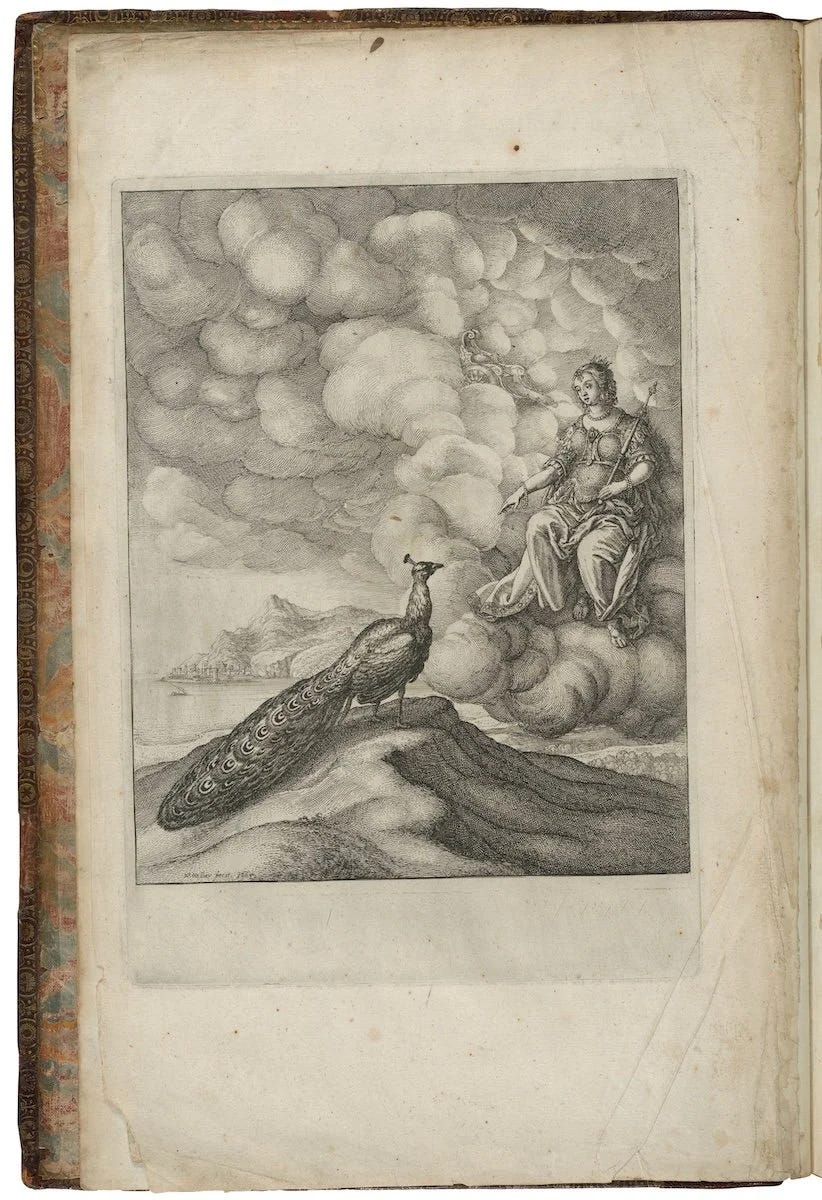
Image: The peacock is companion to Juno, Queen of the Roman Gods. Illustration by John Ogilby, 1668. Folger Shakespeare Library
Shakespeare’s Peacock
The peacock appears six times in Shakespeare: The Comedy of Errors, Hamlet, Henry V, Henry VI Part 1, The Tempest, and Troilus and Cressida.
The bird represents royalty and beauty, as well as pride and vanity. Across Shakespeare’s plays, the peacock exclusively appears in the third or fourth acts, in moments of excess, performance, or impending downfall. The creature that symbolizes kingship also suggests that excessive display may precede a fall.
In Hamlet, we encounter an alternate spelling of the bird as “pajock,” which scholars agree is the peacock. After staging a play that mirrors the murder of his father, Hamlet sees King Claudius react with visible distress. Feigning madness, Hamlet breaks into song but improvises the word “pajock” to reference and mock the pride of the corrupt court.
HAMLET A whole one, I.
For thou dost know, O Damon dear,
This realm dismantled was
Of Jove himself, and now reigns here
A very very—pajock.HORATIO You might have rhymed.
In Henry VI Part 1, Joan of Arc describes the proud Talbot sweeping along “like a peacock,” promising that his enemies will soon “pull his plumes and take away his train.”
Henry VI Part 1, Act III, Scene 3, Line 1
PUCELLE: Dismay not, princes, at this accident,
Nor grieve that Roan is so recoverèd.
Care is no cure, but rather corrosive
For things that are not to be remedied.
Let frantic Talbot triumph for a while,
And like a peacock sweep along his tail;
We’ll pull his plumes and take away his train,
If dauphin and the rest will be but ruled.
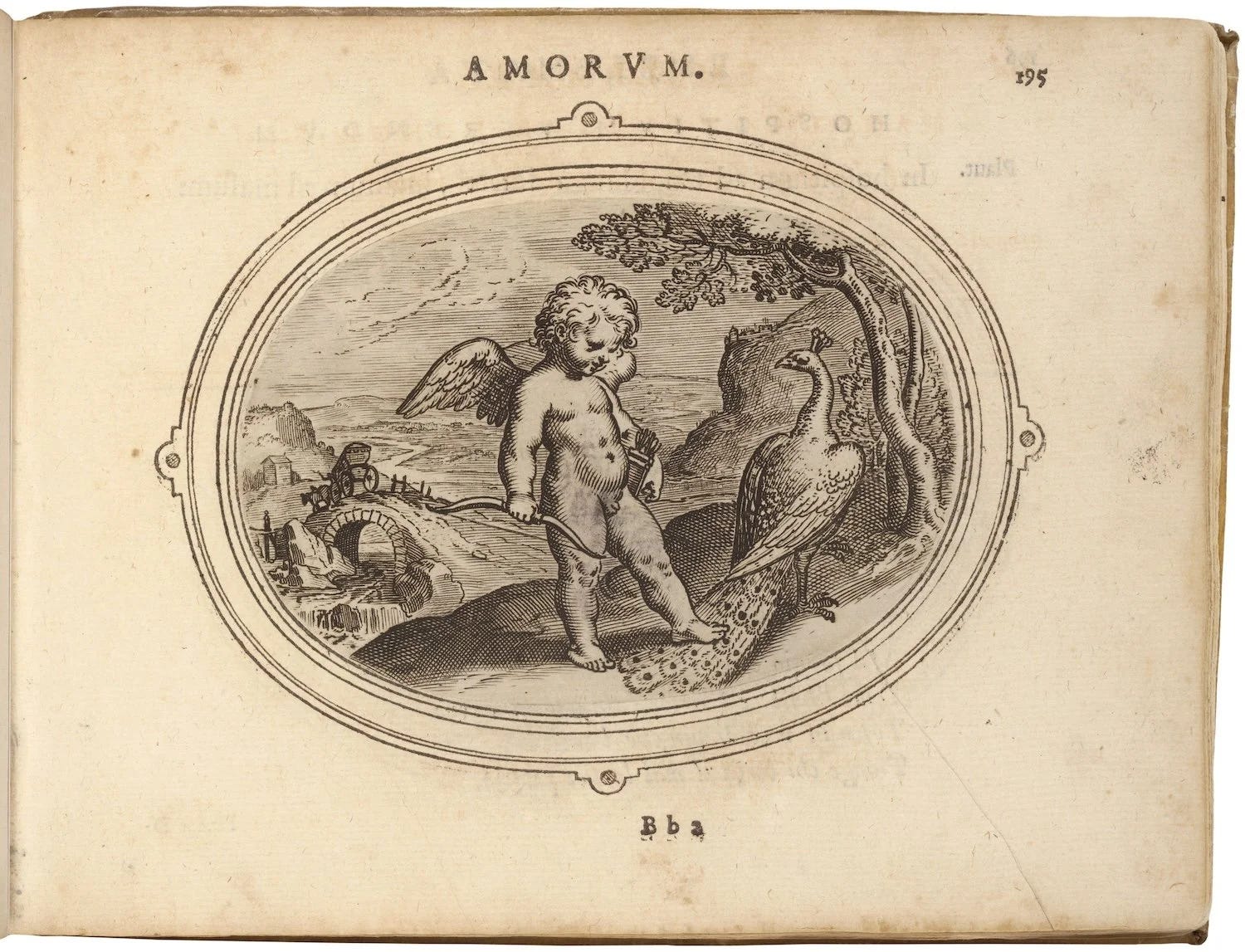
Image: The peacock is sometimes mocked, insulted, or threatened in Shakespeare’s plays and other fables. Illustration by Otto Van Veen, 1608. Folger Shakespeare Library
Behind the Painting
In my painting, I chose to render only the male peacock, the bird we encounter in Shakespeare’s plays. The composition is dotted with three peacock butterflies, one of the most common butterflies in England.
To evoke the peacock’s royal associations, I surrounded the bird with examples of seventeenth-century royal jewelry, including the long strand of pearls worn by Queen Elizabeth I in The Rainbow Portrait. Elizabeth, known as the Virgin Queen, favored pearls because they symbolized purity and virginity. She reigned during fourteen years of Shakespeare’s career.
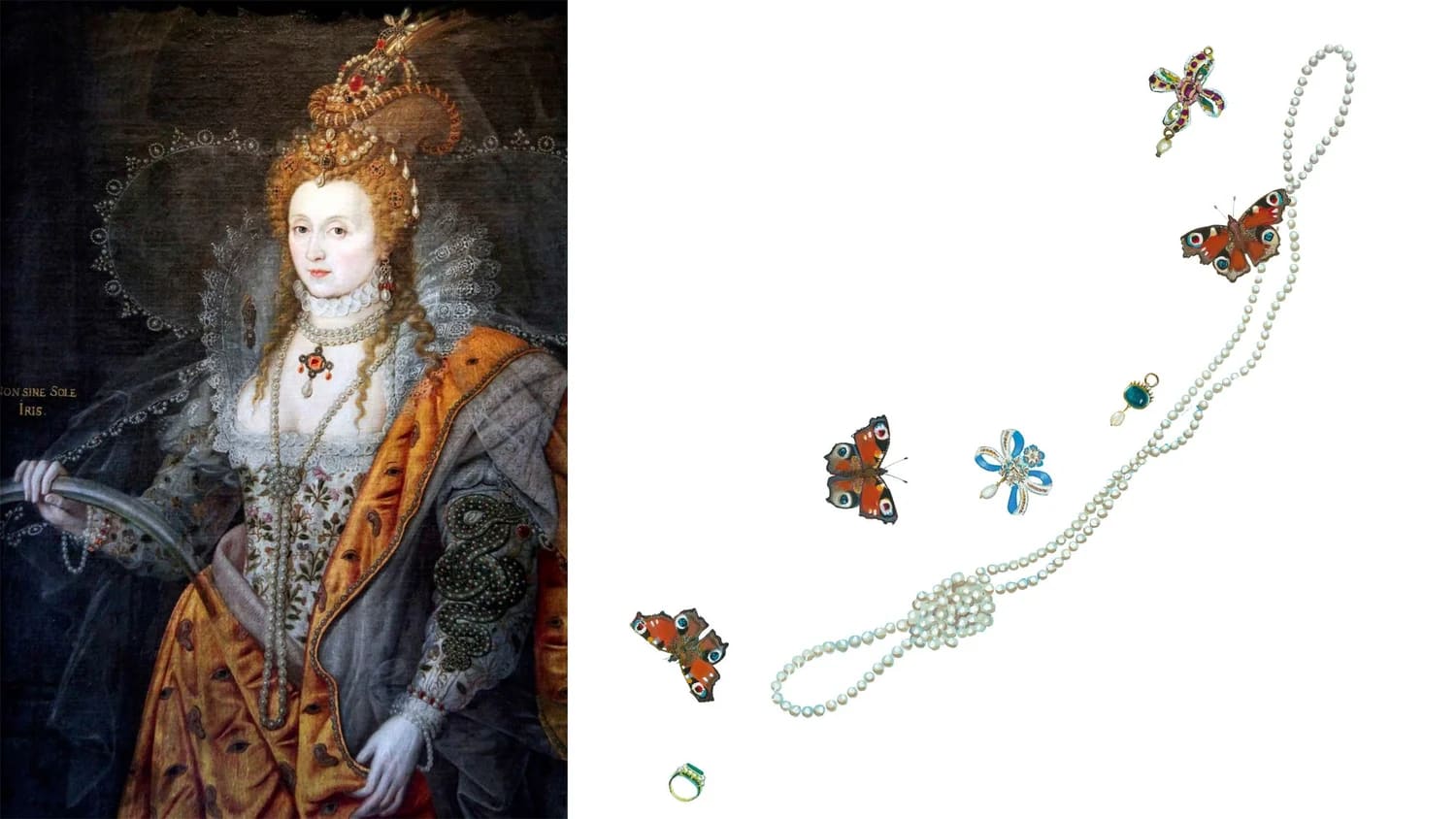
Image: The Rainbow Portrait of Queen Elizabeth I inspired the jewelry selection in my peacock painting.
Bibliography Additions
I came across a neat resource while writing my peacock essay: The Darwin Correspondence Project. This website gathers more than 15,000 of Charles Darwin’s correspondence, with complete transcripts of all the known letters he wrote and received.
It isn’t directly related to Shakespeare, but my research occasionally brushes up against Darwin’s nature writing and theories, such as when I was researching the lifecycle of the barnacle goose.
News & Events
Exhibition | Resilient Roots: Pollinators, Weeds, and the Art of Repair
February - August, 2026
I am exhibiting alongside Aliza Fassler, Bo Kim, and Suzette Marie Martin to explore the powerful, often overlooked connections between the earth’s most persistent plants and the creatures that sustain them. The group show highlights the vital role of pollinators in nurturing ecosystems, while celebrating the resilience of “weeds” and medicinal plants that have adapted, persisted, and transformed across centuries.
The opening reception has passed, but the show will be up through August.
Kinney Center for Interdisciplinary Renaissance Studies
UMass Amherst
650 East Pleasant St
Amherst, MA 01002
Plan your visit
Exhibition | The Birds of Shakespeare
April 4 - May 24, 2026
This will be the largest showing of paintings from The Birds of Shakespeare to date, with sixteen works on display.
St. Alban’s Episcopal Church
885 Shore Road
Cape Elizabeth, ME 04107
stalbansmaine.org
Artist-in-Residence | Kinney Center for Interdisciplinary Renaissance Studies (UMass Amherst)
In July 2026, I will explore the folklore and mythologies surrounding birds in the early modern period to draw connections between the Renaissance imagination and modern ecological concerns about the winged creatures who bear witness to our changing planet. I will dive into the Kinney Center’s collection of original early modern books to learn about Shakespeare’s mythological birds: the griffin, phoenix, harpy, and pegasus.
650 East Pleasant Street
Amherst, MA 01002
About the program
Exit, pursued by a bird
Thank you for subscribing. You can find the full bird profile, including citations and endnotes, at birdsofshakespeare.com/birds.
If you’d like to connect with me, reply to this newsletter or email birdsofshakespeare@gmail.com.
I hope you are enjoying an early spring. The snow is starting to melt in Maine, ushering in mud season, my least favorite month to own chickens.
Until next time,
Missy