

#26 The Barn Owl

Greetings!
For the month of Halloween, we turn to Shakespeare’s eeriest bird, the barn owl, whose ghostly cry haunts the pages of Macbeth and other tragedies.
But first— Upcoming Events
For the first time, six original Birds of Shakespeare paintings will be on view at the Folger Shakespeare Library in Washington, D.C., from November 14 through January 4. Until now, only prints have been exhibited. This show marks a rare chance to see the originals in person.
Artist talk: Friday, November 21st at 6:30 pm *followed by a book signing!
Dates: Fri, Nov 14, 2025 – Sun, Jan 4, 2026
Venue: Stuart and Mimi Rose Rare Book and Manuscript Exhibition Hall
Tickets: Free; timed-entry pass recommended
The Folger Shakespeare Library
201 East Capitol St SE
Washington, DC 20003
Plan your visit

Shakespeare’s Spooky Owl
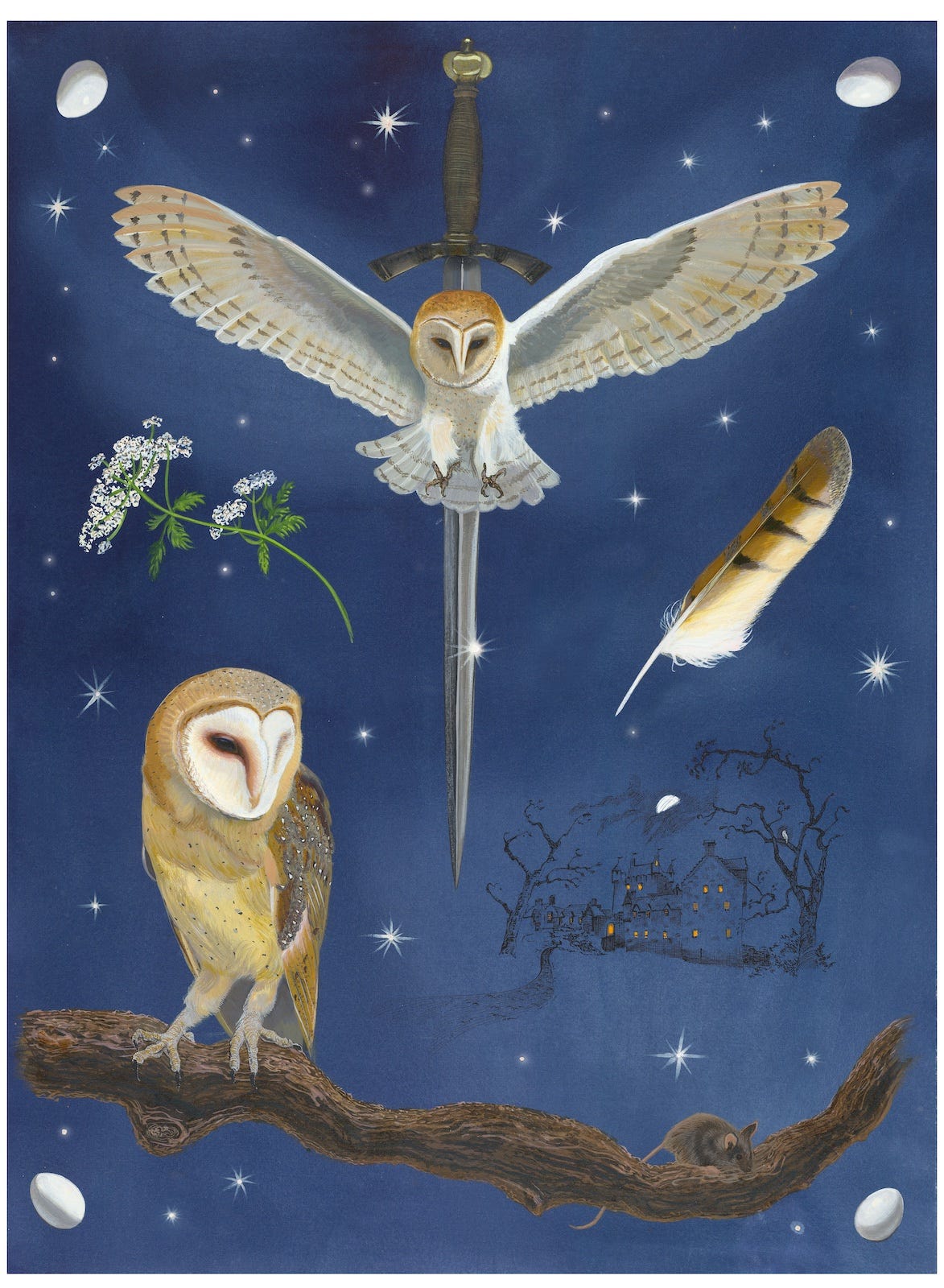
William Shakespeare uses the word “owl” twenty times without ever naming a species. At first, I planned to depict the tawny owl, the most common British owl, as a stand-in for them all. But on closer reading, I noticed that he describes both screeching and hooting owls. This presented a problem: the tawny owl hoots but rarely screeches, while the barn owl, the most common screeching owl, cannot hoot. Shakespeare must have envisioned at least these two species, raising my project’s total from sixty-four to sixty-five birds.
Let’s start with the screeching barn owl because it’s the perfect bird to introduce at Halloween. Superstitions swirl around the barn owl throughout Europe; it may be the most feared and maligned bird I’ve encountered.
Shakespeare casts the barn owl as an omen of doom in The Rape of Lucrece, King Lear, Titus Andronicus, Troillus and Cressida, and Henry VI Parts 1 and 2.
Although Roman mythology venerates the owl as the companion of Minerva, Greek mythology regards it as a symbol of misfortune.
It was a widespread custom in Europe to nail an owl to a barn door to avert the evil eye.
It was also believed that eating owls’ eggs would endow a person with their keen eyesight.
Macbeth’s Owl
The Gaelic name for barn owl conjures an unsettling image of a witch: Cailleach-oidhche Gheal, meaning “white old woman of the night.” Witches and owls have long been intertwined in folklore, so it’s no surprise that the barn owl appears four times in Macbeth, including as an ingredient in the witches’ potion:
Macbeth (Act IV, Scene 1, Line 12)
SECOND WITCH: Fillet of a fenny snake
In the cauldron boil and bake.
Eye of newt and toe of frog,
Wool of bat and tongue of dog,
Adder’s fork and blindworm’s sting,
Lizard’s leg and howlet’s wing,
For a charm of powerful trouble,
Like a hell-broth boil and bubble.
When Lady Macbeth awaits news of Duncan’s murder, she believes the owl’s scream is an announcement of death, a popular early modern interpretation:
Macbeth (Act II, Scene 2, Line 4)
LADY MACBETH: Hark!—Peace.
It was the owl that shrieked, the fatal bellman,
Which gives the stern’st good-night. He is about it.
However, there were more meanings that Lady Macbeth would have been wise to consider. Perhaps the owl was urging the murderous couple to repent their sins, supported by a more sympathetic depiction of a barn owl in the twelfth-century poem, The Owl and the Nightingale.
Barn Owl Facts
Owl feathers are uniquely soft and frayed at the edges, which muffle the sound of flight, enabling them to hunt in silence.
Although owls have excellent night vision, their hearing is their most powerful sense. They hunt almost entirely by sound.
The western barn owl’s ears are positioned asymmetrically on its head, enhancing its ability to locate sounds.
One of my favorite moments volunteering at a wild bird rehabilitation center was getting an up-close look at an owl’s ear. I was holding her carefully when a vet gently lifted her feathers, and I nearly dropped her in shock. Hidden behind each facial disc is a large, fleshy, cavernous ear that takes up nearly half the skull.
Click the image to watch a beautiful video showcasing the owl’s extraordinary hearing.

Behind the Painting
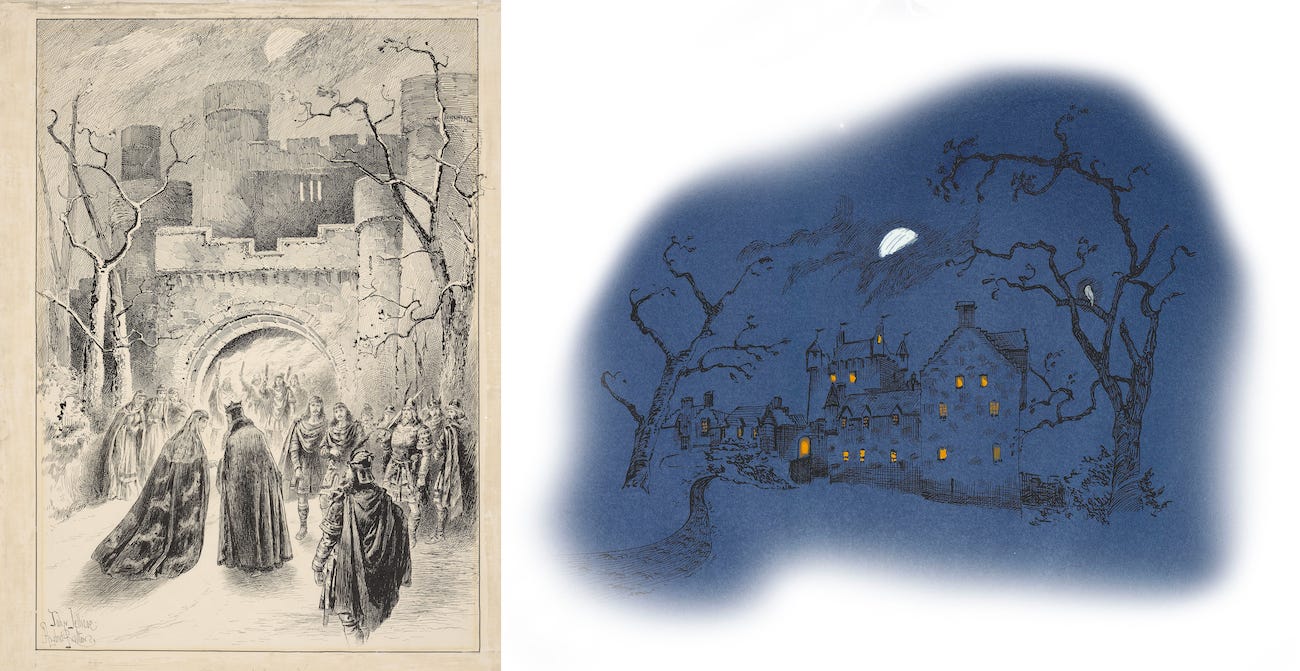
I departed from my usual composition by toning the paper to evoke the owl’s nocturnal world. To mirror its dark reputation, I included the poisonous hemlock, another ingredient in Macbeth’s witches’ brew. I also drew inspiration from John Jellicoe’s 1889 illustration of Cawdor Castle, where King Duncan meets his fate.
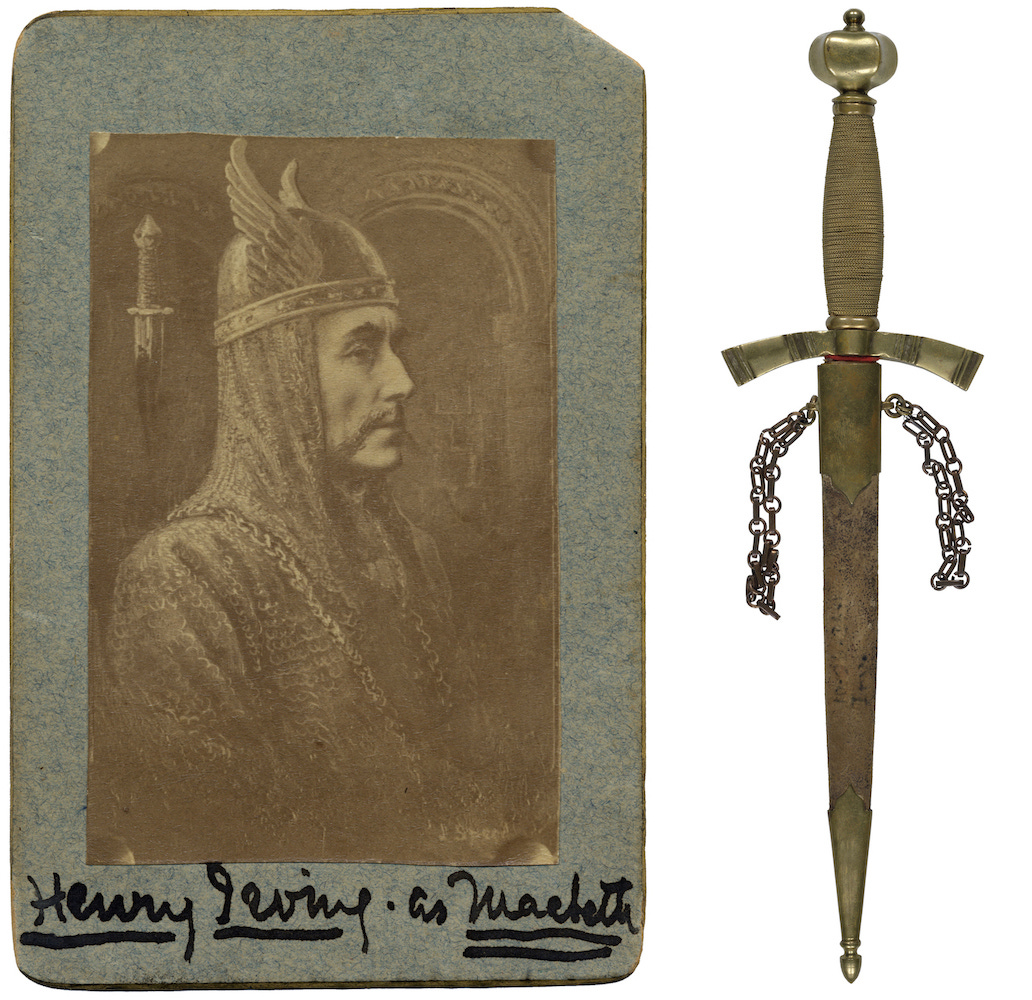
The dagger in my painting was owned by Sir Henry Irving, one of the great Shakespearean actors of the nineteenth century.
Bibliography Additions
I’m always updating my project’s bibliography, and it’s loaded with links you may enjoy! My new favorite resource is JSTOR’s Studying Shakespeare program, which links each line of a play to academic articles discussing it; a treasure trove for exploring how scholars across decades have interpreted Shakespeare’s birds.

Exit, pursued by a bird
Thank you for subscribing. You can find the full bird profile, including citations and endnotes, at birdsofshakespeare.com/birds.
If you’d like to connect with me, reply to this newsletter or email birdsofshakespeare@gmail.com.
Wishing you a fun and spooky Halloween!
Missy